
Are you curious about the health of your lawn? Taking a soil sample is a smart first step.
But how deep should you dig for the most accurate results? Knowing the right depth can unlock the secrets hidden beneath your grass. This knowledge empowers you to make informed decisions that lead to a lush and thriving lawn. Imagine the satisfaction of seeing your lawn in its healthiest form, all from a simple yet precise dig.
Stay with us as we guide you on how deep to dig for the best soil sample, ensuring your lawn gets the care it truly deserves.
:strip_icc()/bhg-excavating-tools_EDNclBiqKUXAQ2GOSD4JP5-83b2610bdddf4bb780bec22ba1a10d19.jpg)
Credit: www.bhg.com
Ideal Depth For Lawn Soil Samples
Taking a soil sample from your lawn helps check its health. The depth of the sample is very important. It affects the accuracy of the soil test.
Different lawns and soil types need different depths for soil samples. Knowing the right depth helps give better results for lawn care.
Factors Influencing Sampling Depth
Several things affect how deep you should dig for a soil sample. These include the type of grass, soil type, and lawn use.
- Grass type:Some grasses have deeper roots than others.
- Soil texture:Sandy soils may need shallower samples than clay soils.
- Lawn use:Lawns with heavy traffic might need samples from deeper soil layers.
- Soil moisture:Wet soil can be easier to sample at certain depths.
Common Depths For Different Lawn Types
Lawn types vary in root depth. Below is a table showing common sampling depths for popular lawn types.
| Lawn Type | Recommended Sampling Depth |
| Cool-season grasses (e.g., fescue, bluegrass) | 3 to 4 inches (7.5 to 10 cm) |
| Warm-season grasses (e.g., Bermuda, zoysia) | 4 to 6 inches (10 to 15 cm) |
| Sod lawns | 4 inches (10 cm) |
| Newly seeded lawns | 2 to 3 inches (5 to 7.5 cm) |

Credit: www.courant.com
Tools For Accurate Soil Sampling
Taking a proper soil sample helps you understand your lawn’s health. Using the right tools makes the process easier and more accurate.
Choosing tools that match your soil type and lawn size ensures good results. This guide covers common tools for soil sampling.
Choosing The Right Soil Probe
A soil probe is a tool designed to remove a small core of soil. It helps collect samples from the correct depth.
- Look for a probe that reaches 6 to 8 inches deep.
- Choose a probe with a sharp tip to penetrate hard soil.
- Metal probes are durable and easy to clean.
- Some probes have a handle for better grip and control.
Using a soil probe lets you take uniform samples. This improves the accuracy of soil testing for nutrients and pH.
Alternative Tools For Sampling
If you do not have a soil probe, use other tools for sampling. These tools help collect soil from the right depth.
| Tool | Use | Depth Range |
| Shovel | Dig small holes and collect soil | 6-8 inches |
| Trowel | Remove soil from shallow areas | 4-6 inches |
| Garden Auger | Drill into soil for core samples | 6-12 inches |
| Handheld Corer | Extract narrow soil cores | 6-10 inches |
Each tool has limits. Pick one that fits your soil type and sample depth needs.
Step-by-step Soil Sampling Process
Testing your lawn’s soil helps you understand its health. Taking soil samples properly gives accurate results. Follow these steps to collect good samples.
This guide shows how deep to dig and how to prepare the site. It also explains how to collect samples that represent your lawn well.
Preparing The Sampling Site
Pick several spots in your lawn to sample. Avoid unusual areas like near trees or flower beds. These may not show the true soil condition.
- Mark at least 5 to 10 locations evenly across your lawn.
- Remove any grass or debris on the surface.
- Use a clean tool to dig into the soil.
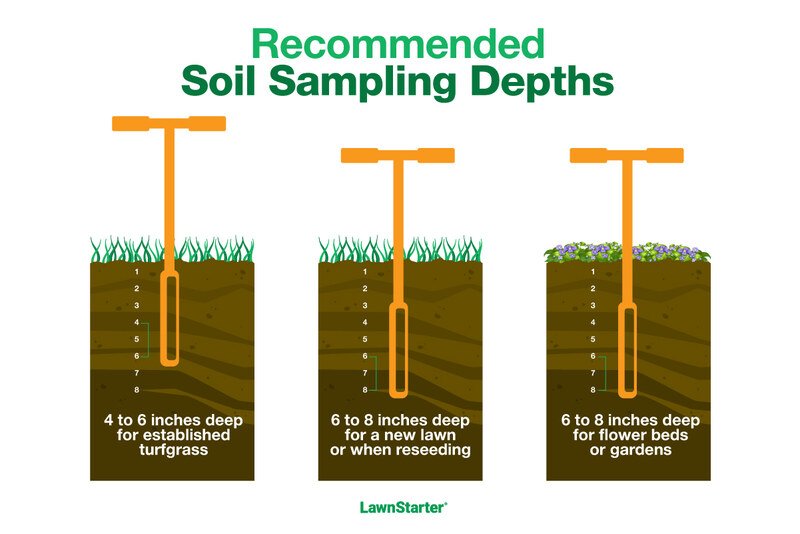
- Dig to the right depth, usually 4 to 6 inches for lawns.
- Place the soil from each spot in a clean container.
Collecting Consistent Soil Samples
Consistency is key for good soil samples. Each sample should be from the same depth and similar soil layer. Mix the samples well before testing.
| Tool | Purpose | Depth to Dig |
|---|---|---|
| Soil Probe | Easiest way to get uniform samples | 4 to 6 inches |
| Trowel or Shovel | Used when no soil probe is available | Dig small hole about 4 to 6 inches deep |
| Clean Container | Hold all soil samples together | N/A |
Credit: www.angi.com
Interpreting Soil Sample Results
Taking a soil sample from your lawn helps you understand its health. The results show what nutrients your soil has or lacks.
Knowing how to read these results helps you care for your lawn better. It guides you on what to add or reduce.
What Nutrient Levels Mean
Nutrient levels show if your soil has enough food for grass. Too little or too much can harm your lawn.
Common nutrients tested include nitrogen, phosphorus, and potassium. Each plays a different role in lawn growth.
- Nitrogen (N):Helps grass grow green and thick.
- Phosphorus (P):Supports strong roots and new growth.
- Potassium (K):Improves lawn’s ability to fight stress.
- pH Level:Shows soil acidity or alkalinity, affecting nutrient use.
Adjusting Lawn Care Based On Results
Use soil results to change your lawn care plan. Add nutrients if levels are low or avoid adding if levels are high.
Adjust soil pH if it is too acidic or too alkaline. This helps your lawn absorb nutrients better.
- Apply fertilizer with the right nutrients for your soil.
- Use lime to raise pH if soil is too acidic.
- Add sulfur to lower pH if soil is too alkaline.
- Water your lawn properly to help nutrient absorption.
Common Mistakes To Avoid When Sampling
Collecting a soil sample from your lawn helps you understand its health. Doing it right ensures accurate results. Avoid errors that could affect soil testing.
Two common mistakes are digging too shallow or too deep and ignoring soil differences across the lawn. Learn how to prevent these errors for better soil care.
Sampling Too Shallow Or Too Deep
Digging the wrong depth changes the soil sample’s content. Soil layers hold different nutrients and moisture. Shallow samples miss nutrients deeper down. Deep samples may include unwanted layers.
- Shallow samples capture only surface soil, missing root zone nutrients.
- Deep samples may mix topsoil with subsoil, confusing test results.
- Standard depth is 4 to 6 inches for most lawns.
- Use a consistent depth for all samples in the same lawn.
- Mark your tools to measure the correct depth easily.
Ignoring Soil Variability
Soil can change in small areas of your lawn. Ignoring this variability leads to wrong soil tests. Different spots may need different care.
| Common Soil Variability Causes | How to Handle |
| Shade vs. sun areas | Sample each area separately |
| High traffic spots | Take more samples from these zones |
| Different grass types | Test each grass type area |
| Soil texture changes | Collect samples where texture differs |
Frequently Asked Questions
How Deep Should I Dig For A Lawn Soil Sample?
Dig about 4 to 6 inches deep to collect a representative lawn soil sample. This depth captures the root zone where most nutrients are absorbed.
Why Is Soil Depth Important For Sampling Lawns?
Soil depth ensures you test the nutrient-rich root zone. Sampling too shallow misses vital information; too deep includes irrelevant layers.
Can I Use A Shovel To Collect Lawn Soil Samples?
Yes, a small shovel or soil probe works well for digging 4 to 6 inches. Avoid tools that compact or contaminate the sample.
How Many Samples Should I Take From My Lawn?
Collect 10 to 15 samples from different spots to get an average soil condition. Mix them for a comprehensive soil analysis.
Conclusion
Digging the right depth for a soil sample helps you understand your lawn better. Usually, 4 to 6 inches deep works well for most lawns. This depth shows what nutrients your grass needs. Taking samples from different spots gives a clearer picture.
Test results guide you on how to improve soil health. Healthy soil means greener, stronger grass. Simple steps lead to a beautiful lawn. Keep testing regularly to maintain good soil quality. Your lawn will thank you with vibrant growth.
