

Are you struggling to get your spreader settings just right? Whether you’re fertilizing your lawn or spreading seeds, the correct spreader settings can make all the difference.
Too much or too little product can harm your grass and waste your money. You’ll discover simple steps to adjust your spreader perfectly every time. Keep reading to learn how to save time, protect your lawn, and get the best results with ease.
Your lawn will thank you!
Choosing The Right Spreader
Setting the right spreader helps apply materials evenly. It saves time and avoids waste.
Picking the right spreader depends on your project size and material type.
Types Of Spreaders
Different spreaders work for different tasks. Knowing types helps you pick the best one.
- Broadcast Spreaders: Spread materials widely and evenly over large areas.
- Drop Spreaders: Drop materials in a controlled line for precise application.
- Handheld Spreaders: Small and portable for spot treatments or small jobs.
- Tow-Behind Spreaders: Attach to vehicles for big jobs on lawns or fields.
Key Features To Consider
Look at features to match the spreader to your needs. Features affect ease and accuracy.
- Spreading Width: Wider widths cover more ground fast.
- Capacity: Larger hoppers hold more material, less refilling needed.
- Adjustable Settings: Lets you control how much material spreads.
- Durability: Strong materials last longer and resist rust.
- Ease of Use: Comfortable handles and smooth wheels help control.

Credit: www.fitfitgarden.co.uk
Preparing Your Spreader
Setting up your spreader correctly ensures even coverage and efficient use of materials. Before you start spreading, spend time preparing your spreader.
Proper preparation helps avoid problems during application and saves you time and money.
Cleaning And Maintenance
Clean your spreader after each use to prevent buildup. Dirt and residue can clog parts and affect performance.
Regular maintenance keeps your spreader working well for a long time.
- Remove leftover material from the hopper.
- Wash with water and mild soap if needed.
- Dry all parts to avoid rust.
- Check for damaged or worn parts.
- Lubricate moving parts as instructed in the manual.
Calibration Basics
Calibrate your spreader to apply the right amount of material. Incorrect settings cause waste or poor results.
Calibration depends on the type of material and the spreader model.
- Check the spreader’s manual for recommended settings.
- Fill the hopper with a test material.
- Set the spreader to a starting setting.
- Spread material over a measured area.
- Measure the amount spread to see if it matches the target rate.
- Adjust the settings up or down as needed.
- Repeat the test until the correct amount spreads evenly.
Adjusting Spreader Settings
Properly adjusting your spreader settings helps ensure even material distribution. It improves efficiency and saves resources.
Spreader settings depend on what material you use and how much you want to apply. Learning these adjustments is important.
Setting The Application Rate
The application rate controls how much material the spreader releases per area. Set it correctly to avoid waste or poor coverage.
Check the spreader’s manual or product label to find the recommended rate. Adjust the setting based on your needs.
- Start with the suggested rate on the product label
- Adjust the spreader dial or speed to match this rate
- Test on a small area to confirm even coverage
- Make small changes if the spread is too light or heavy
Adjusting For Material Type
Different materials flow differently through the spreader. Adjust settings to suit the material type.
Coarse materials may need a wider opening or faster speed. Fine materials may require a slower speed or smaller opening.
| Material Type | Recommended Adjustment |
|---|---|
| Granular fertilizer | Medium opening, moderate speed |
| Fine seed | Small opening, slow speed |
| Sand or lime | Wide opening, faster speed |
| Salt or ice melt | Medium opening, moderate to fast speed |
Credit: www.haytalk.com
Testing For Even Coverage
Setting your spreader correctly is crucial for even coverage. Uneven spreading can cause problems in your lawn or garden. Testing ensures that your settings are just right.
Follow these steps to make sure your spreader covers evenly. It’s easy and can save you time and money in the long run.
Conducting A Test Pass
Start by filling your spreader with a small amount of product. Choose a test area that is flat and visible. This helps you see the spread pattern clearly.
Walk at a steady pace across the test area. Observe how the product falls and spreads. Look for areas that have too much or too little product.
- Use a tarp to catch the product for easy observation
- Repeat the test if needed for better accuracy
- Adjust settings between tests for best results
Identifying And Fixing Gaps
After testing, check for gaps in coverage. Gaps mean parts of your lawn or garden get less product. This can cause uneven growth or pest problems.
Adjust the spreader settings if you find gaps. Make small changes to the spreader opening or walking speed. Test again to see if coverage improves.
- Ensure the spreader is clean and working properly
- Use a measuring tape to check distance between passes
- Consult your spreader’s manual for specific settings
Seasonal And Environmental Adjustments
Setting your spreader correctly helps apply materials evenly. Adjusting settings based on seasons and weather improves results.
Different conditions need different spreader settings. Learn how to adjust for weather and seasonal changes.
Adapting To Weather Conditions
Weather affects how materials spread. Moisture and wind change how far and fast material moves.
- Reduce spreader speed on windy days to avoid drift.
- Use a lighter setting if the ground is wet to prevent clumping.
- Increase spread width on dry, calm days for better coverage.
- Avoid spreading before heavy rain to prevent runoff.
Modifying Settings By Season
Each season requires different spreader adjustments. Temperature and soil type influence the amount to use.
| Season | Recommended Setting | Notes |
| Spring | Medium spread rate | Encourage new growth |
| Summer | Lower spread rate | Avoid burning plants |
| Fall | Higher spread rate | Prepare soil for winter |
| Winter | Minimal or no spreading | Protect dormant plants |
Common Mistakes To Avoid
Setting the spreader correctly is key for effective lawn care. Mistakes can lead to uneven application and poor results.
This guide will help you avoid common issues like overlapping, missed areas, and incorrect calibration.
Overlapping And Missed Areas
Overlapping and missing spots in your lawn can be frustrating. It happens when the spreader is not used properly.
- Ensure consistent walking speed.
- Check the spreader path for coverage.
- Overlap slightly to avoid gaps.
Incorrect Calibration Issues
Calibration problems often lead to uneven spread. This can damage your lawn or waste material.
| Calibration Step | Solution |
| Check Settings | Refer to the manual |
| Test Spread | Use a small test area |
| Adjust Rate | Fine-tune based on results |
Advanced Tips For Professionals
Setting spreader controls accurately saves materials and time. Professionals need precise adjustments for best results. This guide covers key tips to improve your spreader settings.
Using smart tools and customizing settings helps handle different job needs. Learn how technology and fine-tuning can boost your spreader’s performance.
Using Technology For Precision
Modern spreaders often include digital controls and GPS. These tools help apply materials evenly and avoid waste. Using technology can increase accuracy on large or complex jobs.
- Use GPS to track coverage area and avoid overlaps
- Adjust flow rates with digital controls for exact amounts
- Monitor spread patterns with onboard sensors
- Update software regularly to keep systems accurate
- Record data for future job planning and improvements
Customizing Settings For Unique Needs
Each spreading job may require different settings based on material type and ground conditions. Adjust your spreader to match these unique factors for best results.
| Material | Recommended Setting | Notes |
| Fertilizer | Medium flow | Use slower speed on uneven ground |
| Seed | Low flow | Check seed size for spread pattern |
| Salt | High flow | Adjust for temperature and humidity |
| Sand | Medium flow | Use wider spread width for coverage |
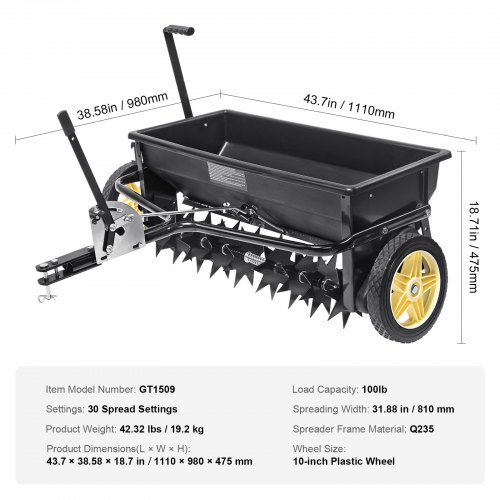
Credit: www.vevor.ca
Frequently Asked Questions
How Do I Adjust Spreader Settings Correctly?
To adjust spreader settings, first identify the material type. Then, consult the manufacturer’s chart for proper calibration. Set the spreader speed and opening size accordingly to ensure even distribution. Test on a small area before full application.
What Factors Affect Spreader Settings Accuracy?
Spreader settings accuracy depends on material type, granule size, and moisture content. Ground speed and spreader calibration also influence results. Regularly clean and maintain your spreader to avoid clogging and uneven spreading. Always test settings before large-scale use.
How Often Should I Recalibrate My Spreader?
Recalibrate your spreader at the start of each season or when changing materials. Also, recalibrate if you notice uneven spreading or after maintenance. Regular calibration ensures precise application, prevents waste, and improves lawn or field health.
Can Incorrect Spreader Settings Damage My Lawn?
Yes, incorrect settings can cause over-application or under-application. Over-application may burn your lawn, while under-application reduces effectiveness. Proper calibration ensures even coverage, promoting healthy growth and preventing environmental harm.
Conclusion
Setting spreader settings correctly helps you spread materials evenly. Check the spread width and rate before starting. Adjust the settings based on the material type and ground condition. Regularly inspect and clean your spreader for best results. Correct settings save time and reduce waste.
Practice and small tests improve your confidence. Follow these tips to achieve a smooth and efficient spreading job every time.
