
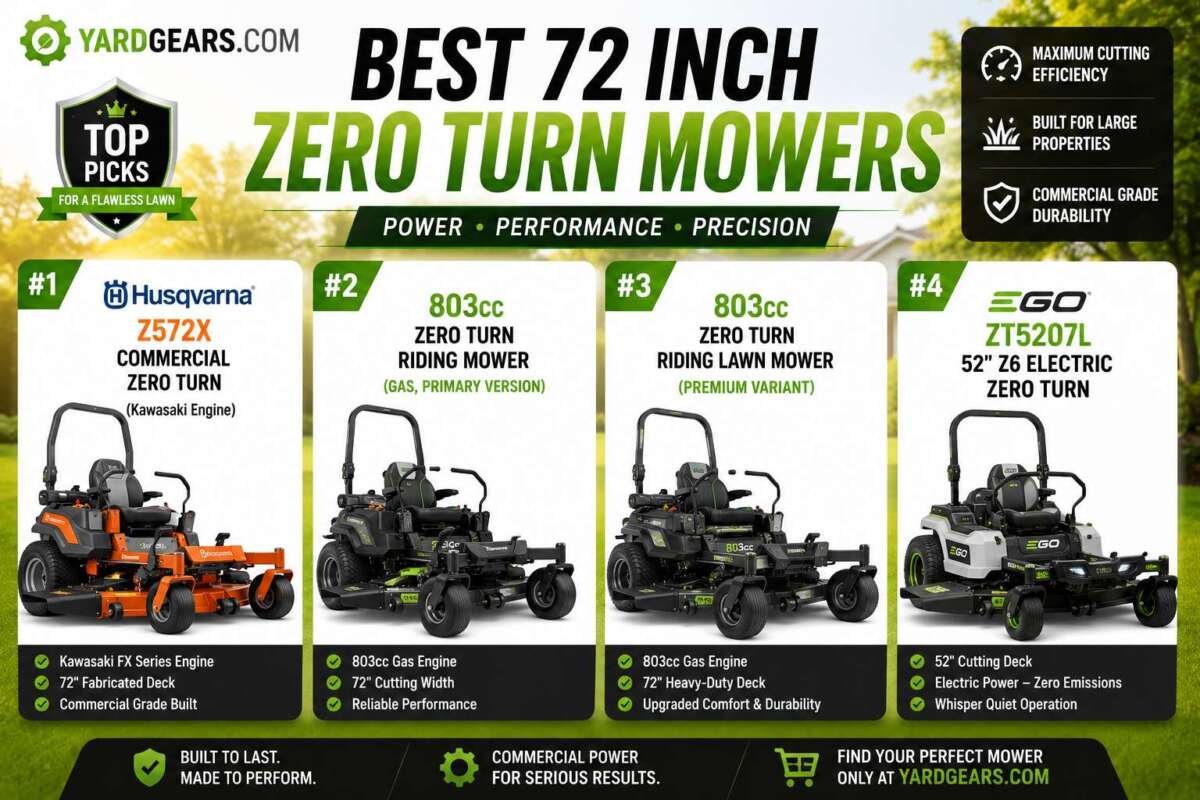
Introduction — When Size Actually Matters
Okay so imagine you’ve got 5 acres to mow. Maybe it’s your property, maybe it’s a client’s lawn — doesn’t matter. You fire up your 48-inch residential mower and you’re out there for two and a half hours sweating in the sun, making pass after pass. Now imagine doing that same job in under an hour. That’s what a 72-inch zero turn mower does for you, and once you’ve used one, going back feels like punishment.
These aren’t just “bigger mowers.” They’re productivity machines built for people who are serious about covering ground fast, clean, and without destroying themselves in the process. Whether you’re running a lawn care business or managing a large estate, the right 72-inch zero turn is one of the best investments you’ll make.
The Short Answer — Which One Should You Get?
For pure commercial power and long-term reliability, the Husqvarna Z572X with a Kawasaki engine is the top pick — full stop. It’s built like a tank, cuts 7 acres an hour, and comes with the kind of engineering that’ll keep running season after season. But if you’re managing a large residential property and want to go gas-free, the EGO ZT5207L is genuinely impressive and gives you zero fuel costs plus near-silent operation.
The 803cc gas mowers offer a compelling middle ground — serious commercial-grade power at a lower price point than the Husqvarna, making them excellent value for either commercial use on a budget or large residential properties.
Here’s the real breakdown: your decision comes down to acreage, budget, and whether you’re running a business or maintaining your own land. Let’s dig into each one properly.
Why 72 Inches? Understanding the Big Deck Advantage
Let’s be honest — a 72-inch deck is a beast, and it’s not for everyone. But when it fits your situation, the productivity gains are genuinely dramatic.
The math: A 72″ deck at 8 mph covers roughly 6–8 acres per hour. A 48″ deck at the same speed covers about 4 acres per hour. That’s almost double the output per hour of work.
For a lawn care professional charging by the job, that difference is money. For a property owner with 3–10 acres, it’s the difference between mowing taking your whole Saturday versus a couple of hours before lunch.
The other reason you’d go 72 inches is cut quality at scale. A properly designed wide deck distributes blade overlap more evenly, reducing the stripiness you sometimes see with narrower overlapping passes. You get a cleaner, more professional finish across large open areas.
The tradeoff is obvious: a 72-inch deck won’t squeeze through a 3-foot gate, struggles in heavily landscaped yards with lots of tight obstacles, and needs a larger trailer to transport. If your property has narrow areas, tree islands, or tight fencing, you’ll likely pair this machine with a smaller trim mower.
What Makes a Great Zero Turn Mower?
Before we get into the specific models, here’s what actually separates a good 72-inch zero turn from a great one — because the specs alone don’t tell the whole story.
Engine reliability is everything. Commercial zero turns run hard, often in heat, often for hours on end. An engine that sounds impressive on paper but runs hot and needs constant maintenance is a liability. Look for Kawasaki, Yamaha, or Kohler engines — these are the names that professional landscapers trust and dealers can actually service.
Deck construction matters more than you’d think. Stamped decks are fine for residential use — they’re lighter and cheaper. Fabricated decks (welded steel construction) hold up to the abuse of commercial use, resist warping, and maintain consistent blade height across the full 72 inches over time. For a 72-inch machine, you want fabricated.
Transmission quality determines how smooth your turns are and how long the drivetrain lasts. Hydro-Gear ZT-5400 is the gold standard for transmissions in this class — it’s what you’ll find on commercial-grade machines and it handles the torque demands of a 72-inch deck reliably.
Operator comfort sounds like a luxury, but on a machine you’re running for 4–8 hours a day, it’s a performance factor. Suspension seats, armrests, vibration dampening, and ergonomic lap bar positioning all reduce fatigue — and a less tired operator makes fewer mistakes and works faster.
Serviceability is the one nobody thinks about until they’re staring at a breakdown mid-season. Can you get parts locally? Is the dealer network solid? Is the machine designed so you can access filters, belts, and blades without a full teardown? These are the questions experienced buyers ask.
The Top 5: Full In-Depth Reviews
#1 — Husqvarna Z572X Commercial Zero Turn (Kawasaki Engine)
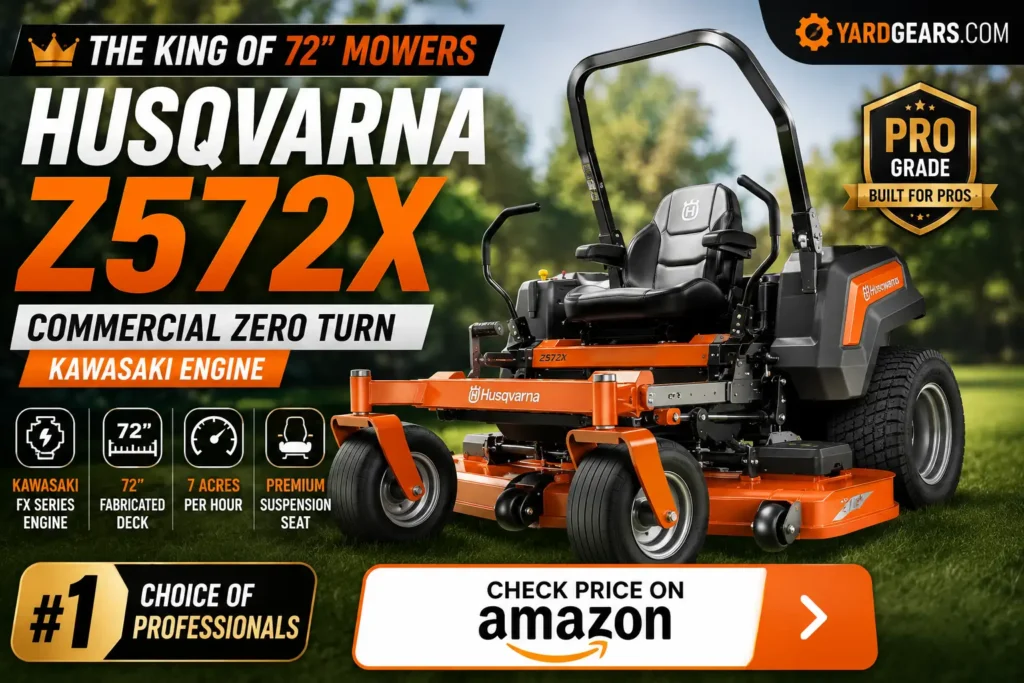
Alright, let’s start with the king. The Husqvarna Z572X is what professional landscapers actually run when money matters and downtime isn’t an option. This thing is engineered from the ground up for commercial use, and you can feel it the moment you sit down.
The Engine:
It runs a Kawasaki FX Series V-Twin — the same engine family you’ll find in machines costing twice as much. Kawasaki’s FX engines are legendary in the commercial mowing world for good reason: they’re built for full-throttle operation all day long, feature full-pressure lubrication with an oil filter (not just splash lubrication like cheaper engines), and they don’t flinch in 95°F summer heat.
The Deck:
The 72-inch cutting deck is 7-gauge fabricated steel — seriously heavy-duty construction. This isn’t a stamped deck that’ll warp after a few hard seasons. The fabricated construction means consistent blade height and structural integrity even after years of commercial use. The three-blade system produces a blade tip speed that delivers clean, professional cuts even through heavy, wet grass.
The Performance:
At its rated productivity of 7 acres per hour, the Z572X is genuinely one of the most efficient machines in its class. Forward speed pushes to 12+ mph, which is fast enough that terrain quality becomes the limiting factor, not the mower. The zero-turn radius is tight and responsive — you’ll maneuver around trees and landscape features with precision that would be impossible on a traditional riding mower.
Comfort and Ergonomics:
The premium suspension seat is a legitimate feature, not a marketing line. On a machine you’re running for 6 hours straight, a properly suspended seat significantly reduces back fatigue. Add adjustable armrests, ergonomically positioned lap bars, and vibration dampening throughout the frame, and this is a machine that respects the operator.
Maintenance:
Husqvarna designed the Z572X with serviceability in mind — easy access to the air filter, oil filter, belt system, and blade spindles. The ZT-5400 Hydro-Gear transmission is industry-standard and parts are widely available.
Who It’s For:
- Professional landscapers running routes daily
- Property owners with 5+ acres of open turf
- Anyone who needs a machine that will run hard for years without drama
Pros:
- Kawasaki FX engine is best-in-class for reliability
- 7-gauge fabricated deck built for commercial abuse
- 7 acres/hour productivity
- Premium suspension seat for operator comfort
- Strong dealer and parts network
Cons:
- Premium price point (this is a commercial-grade investment)
- Full-size footprint — needs appropriate transport and storage
- Heavier than residential models, so soft wet ground can be a concern
Our Verdict: The Husqvarna Z572X is the benchmark. If you’re serious about mowing efficiency and long-term reliability, this is the machine you’re working toward.
#2 — 803cc Zero Turn Riding Mower (Gas, Primary Version)
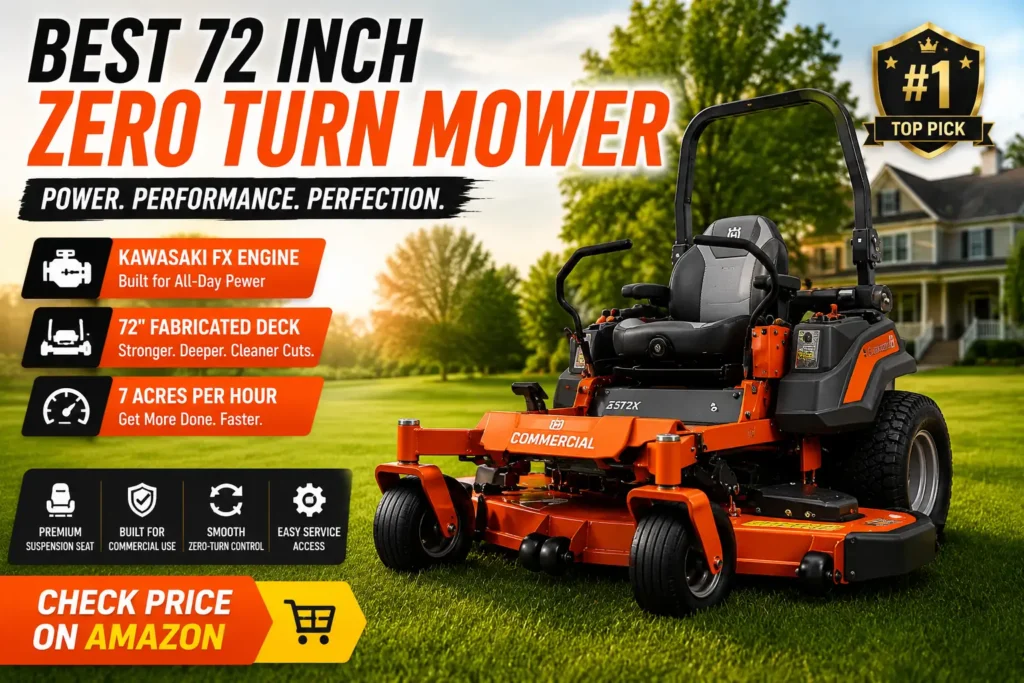
Here’s the thing about the 803cc mower — it punches well above its price point, and if you’re a property owner or a small lawn care operation on a budget, this machine deserves serious consideration.
The Engine:
The 803cc gasoline engine is the headline feature, and it’s the right one to lead with. 803cc displacement puts serious torque through that 72-inch deck — enough to handle thick, overgrown grass that would bog down smaller engines. This isn’t the kind of machine that feels like it’s struggling when the grass gets long and dense. It pulls through with authority.
The Deck:
A 72-inch fabricated cutting deck means you’re getting the full professional-width cut, not a compromise. The three-blade setup maintains consistent overlap across the full deck width, giving you that clean, even striping on open lawn areas.
The Transmission:
Look for the Hydro-Gear ZT-3800 transmission on this model — a step below the ZT-5400 in the Husqvarna, but still a genuine commercial-grade hydrostatic unit that delivers smooth, responsive zero-turn performance. You get the tight turning radius you need to work efficiently around obstacles.
Zero-Turn Capability:
This is where zero turns earn their price tag. You genuinely can spin in place — the inside rear wheel stops and the outside one drives, creating a rotation point that lets you reverse direction without a three-point turn. On a 72-inch machine, that capability is what makes large properties manageable rather than exhausting.
Comfort:
A high-back seat, adjustable lap bars, and cup holder (yes, that matters on a long mowing day) round out the comfort package. It’s not quite at the Husqvarna’s suspension seat level, but for the price difference, the tradeoff is reasonable.
Who It’s For:
- Property owners with 3–8 acres who want commercial-grade width without the commercial price
- Small lawn care businesses looking for value and performance
- Anyone upgrading from a 42–54″ residential mower and ready for a serious step up
Pros:
- 803cc engine provides genuine commercial-grade torque
- Full 72-inch fabricated deck for maximum productivity
- Zero-turn maneuverability
- Strong value for the price
Cons:
- Not quite the engine pedigree of Kawasaki or Kohler branded motors
- May have more limited dealer service network vs. Husqvarna
- Heavier operation curve for first-time zero turn usersOur Verdict: The 803cc gas mower is the “serious value pick” — a lot of commercial capability for less money than the premium brands demand.
#3 — 803cc Zero Turn Riding Lawn Mower (Premium Variant)
This is the premium variant of the 803cc platform, and the differences from #2 are worth understanding before you decide between them. Think of it this way: if Model #2 is the workhorse that gets the job done, Model #3 is the workhorse with a few extra creature comforts and refinements.
What’s Different:
The same powerful 803cc engine foundation is here, but the build finish, seat quality, and control ergonomics are stepped up. The frame construction often features additional reinforcement, the seat is more substantially cushioned for longer sessions, and the control layout tends to be more refined — less friction in your daily operation.
Deck and Performance:
Still a full 72-inch fabricated steel cutting deck, still three blades, still the same productivity numbers you’d expect from this displacement class. If anything, the slightly improved blade engagement mechanism on this variant means cleaner starts and more consistent RPM maintenance under load.
The Transmission:
Same Hydro-Gear-class hydrostatic transmission — smooth, zero-turn capable, and reliable in the conditions these machines are designed for.
Ergonomics and Operator Experience:
Here’s where the premium variant earns its slight price premium. The seat suspension, vibration dampening, and armrest design are noticeably better than the standard variant. For a property owner doing 2–3 hours per week, that difference is minor. For a commercial operator running 6+ hours daily, it’s meaningful fatigue reduction.
Who It’s For:
- Commercial operators who want the 803cc value proposition but spend long hours in the seat
- Property owners who want the best possible comfort without moving all the way to Husqvarna pricing
- Anyone who tried the standard variant and wished the ride quality was a bit better
Pros:
- Same proven 803cc engine in a more refined package
- Superior seat comfort for long sessions
- Improved ergonomics over the standard variant
- Full 72-inch deck width
Cons:
- Price premium over Model #2 may not be worth it for light-use property owners
- Still doesn’t match Husqvarna’s parts availability and dealer networkOur Verdict: If you’re choosing between #2 and #3, go #3 if you spend significant hours in the seat — the comfort refinements are worth the difference. Go #2 if you want maximum value and don’t mind a simpler setup.
#4 — EGO ZT5207L 52″ Z6 Electric Zero Turn
Okay, let’s talk about the wildcard in this list — and hear me out before you scroll past it. The EGO ZT5207L is a 52-inch electric zero turn, not a 72-inch gas machine. So why is it on this list? Because if your property doesn’t need a full 72-inch cut and you’re serious about going electric, this is the best zero turn in the electric space right now — and it changes the conversation about what’s possible without gas.
The Electric Powertrain:
EGO runs 5 independent brushless motors — one for each rear drive wheel and three for the blade spindles. Total power output is rated at 25 horsepower equivalent. Now, “equivalent” is a marketing claim that requires some skepticism, but the real-world numbers back it up: this mower handles thick grass, moderate slopes, and extended sessions without bogging down in a way that surprises most people expecting electric to be “wimpy.”
The Battery System:
Six EGO 12.0Ah 56V ARC Lithium batteries come in the kit. On a single full charge, you can cut up to 4 acres. In practical terms, for a 2–3 acre property, you’ll finish on one charge comfortably with battery to spare. For 4 acres, you’re cutting it close depending on grass thickness and conditions.
Runtime reality check: EGO claims up to 4 acres per charge. Real-world users in heavy grass or hilly terrain report closer to 2.5–3 acres before needing a charge. Factor that into your decision.
The Deck:
A 52-inch, 10-gauge fabricated steel deck — notice that “fabricated” designation, which is unusual for an electric mower at this price point and a genuinely good sign. Ten cutting height positions from 1.5″ to 4.5″ give you real flexibility. The three-blade system produces clean, consistent cuts.
The Experience:
Here’s what nobody tells you about running an electric zero turn: the experience is genuinely different in ways you’d love. Zero vibration from engine harmonics. Near-silent operation — you can hear birds while mowing. No exhaust fumes in your face on a hot day. No oil changes, no fuel, no spark plugs. Maintenance is dramatically simpler.
Speed and Maneuverability:
Top speed of 8 mph in Sport mode — actually faster than many gas zero turns in this class. Three driving modes (Control, Standard, Sport) let you match the aggressiveness of the drive system to your terrain and comfort level.
Who It’s For:
- Property owners with 2–4 acres who want zero maintenance and zero fuel costs
- Environmentally conscious buyers
- Residential users in HOA communities or noise-sensitive neighborhoods
- Anyone who wants the zero turn experience without the gas complexity
Pros:
- Completely silent, zero-emission operation
- No fuel, no oil changes, minimal maintenance
- 25 HP equivalent — serious cutting power for an electric
- 3 driving modes for terrain flexibility
- Eligible for various state and local electric equipment rebates
Cons:
- 52″ deck, not 72″ — lower productivity per hour on large properties
- 4-acre range limit (real-world closer to 3 acres in thick grass)
- High upfront cost including 6 batteries
- Charging time means a hard stop if you run out mid-lawnOur Verdict: The EGO ZT5207L is the best electric zero turn on the market. If gas-free operation appeals to you and your property fits within its 3–4 acre runtime, it’s a genuinely compelling machine.
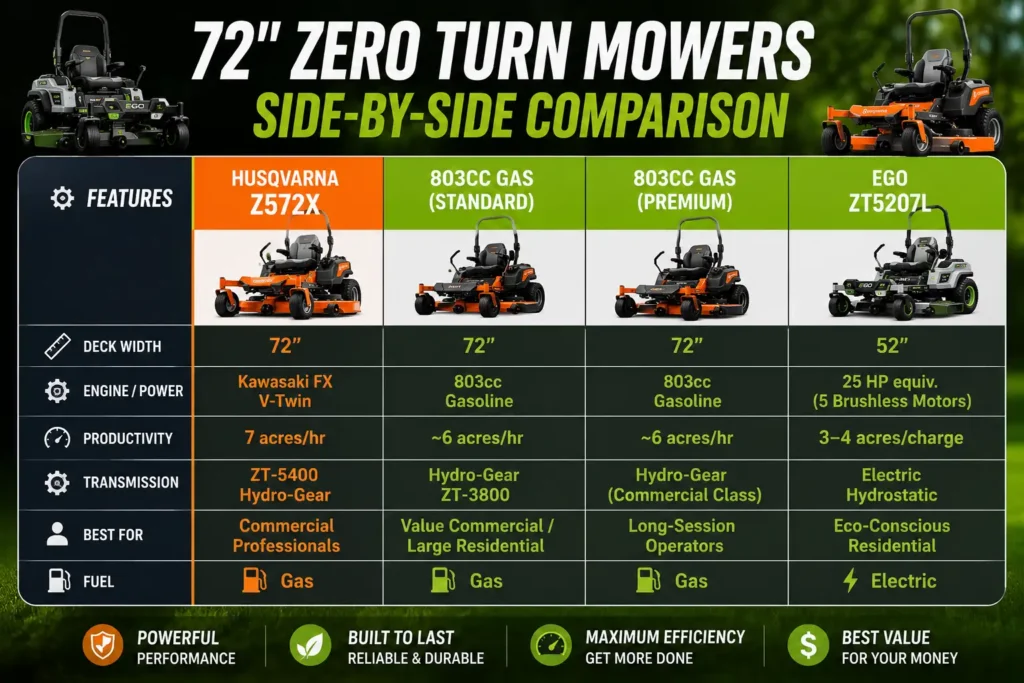
Side-by-Side Comparison Table
| Model | Deck Width | Engine/Power | Productivity | Transmission | Best For | Fuel |
|---|---|---|---|---|---|---|
| Husqvarna Z572X | 72″ | Kawasaki FX V-Twin | 7 acres/hr | ZT-5400 Hydro-Gear | Commercial professionals | Gas |
| 803cc Gas (Standard) | 72″ | 803cc gasoline | ~6 acres/hr | Hydro-Gear ZT-3800 | Value commercial/large residential | Gas |
| 803cc Gas (Premium) | 72″ | 803cc gasoline | ~6 acres/hr | Hydro-Gear class | Long-session operators | Gas |
| EGO ZT5207L | 52″ | 25 HP equiv. (5 brushless motors) | 3–4 acres/charge | Electric hydrostatic | Eco-conscious residential | Electric |
Who Should Buy What? 5 Real Scenarios
Scenario 1: The Professional Landscaper Running Daily Routes
You’re mowing 15–25 lawns a week. Your machine needs to start every morning, run all day in the heat, and not break down mid-season. Get the Husqvarna Z572X. The Kawasaki engine, commercial warranty, and dealer network are what this profession demands. The premium price is a business investment that pays for itself in avoided downtime.
Scenario 2: The 5-Acre Property Owner on a Budget
You have a large property, you’re not running a business, and you want commercial performance without the commercial price tag. Get the 803cc Standard. It gives you 72 inches of cutting width and a serious engine at a price point that won’t make your eyes water.
Scenario 3: The Operator Who Runs 6+ Hours a Day
You’re a commercial operator who spends long days in the seat. Fatigue is a real issue. Get the 803cc Premium variant. The seat comfort and ergonomic refinements are meaningful when you’re logging those hours. If budget allows, step up to the Husqvarna for maximum long-term reliability.
Scenario 4: The Eco-Conscious Property Owner with 2–3 Acres
You hate the smell of gas, you love quiet Sunday mornings, and your lawn is 2–3 acres. Get the EGO ZT5207L. You’ll finish your whole lawn on one charge, spend nothing on fuel, and do next to zero maintenance beyond keeping the batteries charged.
Scenario 5: The Small Lawn Care Business Getting Started
You’re starting a lawn care operation and watching every dollar. The 803cc mowers offer commercial-grade cutting width and engine power at a lower entry price. Start with the Standard 803cc, build your client base, and upgrade to Husqvarna when the revenue justifies it.
Common Mistakes & Myths
Myth 1: “Bigger deck always means faster job.”
A 72-inch deck only helps you if your properties are open enough to use it efficiently. If you’re spending extra time doing trim work with a push mower because the 72-inch can’t fit through gates or around tight landscaping, you may be slower overall than you’d be with a 60-inch that needs less trim follow-up. Right-size your deck to your actual properties.
Myth 2: “Electric mowers can’t handle real commercial work.”
The EGO ZT5207L handles properties up to 4 acres and delivers 25 HP equivalent power. That’s genuinely capable. The limitation is runtime, not power — and for properties within that range, it outperforms many gas machines in consistency and ease of use. Electric is a legitimate commercial option for the right scale of work.
Myth 3: “All hydrostatic transmissions are the same.”
They are absolutely not. The difference between a budget hydrostatic and a Hydro-Gear ZT-5400 is the difference between a transmission that lasts 2,000 hours and one that starts giving you trouble at 600. The transmission is often more expensive to replace than the engine — buy a machine with a respected transmission from the start.
Myth 4: “Zero turns are hard to control.”
The learning curve for zero turn operation is about 20–30 minutes. After that, most users find them dramatically more intuitive than traditional riding mowers. The lap bar controls become second nature quickly, and the precision you gain over a standard steering wheel mower is immediately obvious.
Myth 5: “You only need to service it when something breaks.”
Zero turns have engine oil, air filters, blade sharpening, belt inspection, and hydraulic fluid all needing regular attention. A machine that runs 200+ hours a season should be serviced every 50–100 hours or annually, whichever comes first. Skipping this is how expensive engines become expensive repairs.
Nuance & Exceptions
If your property has significant slopes: Zero turns can be risky on steep grades — the drive system makes them prone to sliding on hills above 15–20 degrees. If slopes are a major part of your property, consider a dedicated hill-capable machine or a stand-on zero turn with better weight distribution. The EGO explicitly rates for slopes up to 15°.
If you’re in a wet climate: Wide fabricated decks can build up significant grass clumping underneath in wet conditions. Look for machines with good anti-clog deck designs and scraper kits available as accessories. Running a deck wash-out port (a hose connection under the deck) is a game-changer for wet-climate maintenance.
If you’re running a commercial operation with multiple crew members: The Husqvarna Z572X’s commercial warranty covers multiple operators in a commercial setting. Many “commercial-grade” machines from lesser brands only warrant single-owner residential use — read the warranty terms before buying for crew use.
If fuel costs are a major concern: With gas prices volatile and labor costs rising, the EGO’s electric operating cost math is genuinely compelling for the right property size. Electricity to charge 6 batteries costs a fraction of the fuel a comparable gas machine burns per hour. Over 3–5 years of ownership, the savings offset a significant portion of the higher purchase price.
If you’re buying for a lawn care business, check local dealer support first. A Husqvarna with a dealer 5 miles away beats a theoretically superior machine whose nearest dealer is 80 miles out. When your equipment goes down mid-season, proximity matters more than any spec on a brochure.
FAQ
How many acres can a 72-inch zero turn mow per hour?
At typical operating speeds, a 72-inch zero turn mower covers 6–8 acres per hour in open, obstacle-free conditions. The Husqvarna Z572X, for example, is rated at 7 acres per hour. Real-world productivity drops by 15–25% when you factor in turning, obstacles, and terrain variation — so budget for roughly 5–6 effective acres per hour in typical conditions. This is still roughly double what a 48-inch machine would cover, which is why the 72-inch class makes financial sense for commercial operators and large-property owners.
Is the Husqvarna Z572X worth the premium price over cheaper 72-inch mowers?
For commercial use, yes — emphatically. The Husqvarna Z572X’s Kawasaki FX engine, 7-gauge fabricated deck, Hydro-Gear ZT-5400 transmission, and commercial dealer network represent a total package that budget machines simply can’t match at the component level.
The real calculation is total cost of ownership: a cheaper machine that requires a transmission rebuild at 800 hours or an engine replacement at 1,200 hours can cost more over 5 years than the Husqvarna’s premium purchase price. For purely residential use on 3–5 acres, the premium may be harder to justify — the 803cc alternatives offer strong value.
Can a zero turn mower handle wet or long grass?
Yes, but with caveats. A powerful engine (803cc or Kawasaki FX-class) combined with a fabricated deck handles wet and long grass significantly better than underpowered or stamped-deck machines. In very wet conditions, reduce your speed by 20–30% to prevent clumping under the deck and blowout issues.
Most commercial zero turns perform well in grass up to 8–10 inches tall — beyond that, you’re better off doing a double-pass at higher cutting height first, then coming back to finish. Always ensure blades are sharp before tackling long overgrown grass; dull blades tear rather than cut, dramatically reducing quality and engine efficiency.
What’s the maintenance schedule for a commercial zero turn mower?
For a gas-powered commercial zero turn, the standard schedule is: oil change every 50 hours (more frequently for the first 5–8 hours of a new machine), air filter check every 25 hours and replacement as needed, blade sharpening every 20–25 hours of use, belt inspection every 100 hours, and hydraulic fluid service per the manufacturer’s recommendation (typically 200–500 hours depending on the machine).
Practically, a machine running a full commercial season should receive a full service inspection each spring before the season begins and blades should be sharpened 3–4 times per season. For the EGO electric, maintenance is dramatically simpler: keep batteries charged, clean the deck, and sharpen blades.
How does the EGO ZT5207L compare to gas zero turns for real commercial use?
The EGO ZT5207L is genuinely capable for properties within its 3–4 acre runtime range. Where it falls short for heavy commercial use is total daily capacity — a gas machine can be refueled in 2 minutes and run all day; the EGO requires charging time (about 60–90 minutes for a full battery set depending on charger) which limits back-to-back large lawn completion.
For a lawn care route of moderate-sized residential properties (1–3 acres each), the EGO can work well if your route is structured to allow charging between jobs or if you have a second battery set. For large commercial properties or routes without charging breaks, gas remains the practical choice.
What’s the difference between a stamped deck and a fabricated deck on a zero turn mower?
This is one of the most important spec differences to understand when buying in this class. A stamped deck is formed from a single piece of steel pressed into shape — it’s lighter and cheaper to manufacture but more prone to warping under high stress and impact. A fabricated deck is welded from multiple heavy-gauge steel pieces, creating a rigid structure that maintains consistent geometry under hard use.
For a 72-inch machine in commercial use, fabricated is non-negotiable — the deck spans a wide area and takes constant impact from rocks, roots, and debris. A warped 72-inch deck results in uneven cuts across the full width, which is a major quality problem in professional work.
Can I transport a 72-inch zero turn mower in a standard truck or trailer?
A 72-inch zero turn won’t fit in a standard pickup truck bed without the deck hanging over the edges significantly — transport this way is not safe or recommended. You need at minimum a 6-foot wide trailer (an 83-inch wide open trailer works), and ideally a 7-foot-wide enclosed trailer if you’re running a commercial operation that needs equipment security.
The machine itself is also heavy — typically 1,200–1,800 pounds depending on the model — so your trailer’s weight rating and your tow vehicle’s capacity need to be verified before purchase. For property owners who don’t move the machine, this is a non-issue. For commercial operators, factor trailer cost into your total equipment budget.
How long do 72-inch zero turn mowers last?
A quality commercial zero turn with proper maintenance should last 2,000–3,000 engine hours before a major engine rebuild or replacement is needed. Kawasaki and Kohler commercial engines are known to push beyond that with diligent maintenance.
In practical terms, a lawn care professional running 500 hours per season can expect 4–6 seasons from a well-maintained machine before major overhaul costs. Commercial-grade transmissions (Hydro-Gear ZT-5400) typically match or exceed engine longevity with proper fluid maintenance.
Budget-grade machines from less established brands may see significant component failures at 600–900 hours — which is why engine, transmission, and deck pedigree matter so much in this category.

